Printing and Dyeing: Similarities and Differences
I. Differences Between Dyeing and Printing
PART 01
-
Dyeing solutions generally do not contain thickening pastes or only add a small amount of them, while printing pastes usually require the addition of a relatively large quantity of thickening pastes. This is to prevent pattern bleeding (which would cause blurred or distorted pattern outlines) and dye migration during drying after printing.
-
The dye concentration in dyeing is generally not high, so the problem of dye dissolution is not significant, and co-solvents are often not added. However, the dye concentration in printing pastes is relatively high, and the necessity of adding a large amount of paste to the color paste makes dye dissolution difficult. Thus, a greater amount of co-solvents (such as urea, alcohol, and solubilizing salt B) are often added.
-
During dyeing (especially exhaust dyeing), the fabric remains in the dye bath for a long time, allowing the dye to fully diffuse and penetrate into the fibers to complete the dyeing process. In printing, after the paste added to the color paste is dried to form a film, the polymer film layer hinders the diffusion of dye into the fibers. It is therefore necessary to rely on post-treatment processes such as steaming and baking to increase the dye diffusion rate and facilitate dyeing of the fibers.
-
In dyeing, it is rare to blend two different types of dyes for color matching (except when dyeing blended fabrics). In contrast, printing often involves using different types of dyes for co-printing, or even mixed-paste printing. Additionally, there are various processes such as discharge printing, resist printing, and reserve printing, making printing process design distinct from that of dyeing.
-
Printed fabrics include products with white-ground printing, discharge white printing, or resist white printing. Therefore, the pre-treatment of grey printed fabric semi-finished products requires a whiteness level similar to that of bleached fabric semi-finished products, whereas the whiteness requirement for dyed fabric semi-finished products is relatively lower.
-
Dyed fabric semi-finished products require good capillary effect to facilitate the diffusion and penetration of dyes into the fibers during dyeing. In printed fabric processing, printing and drying are continuous processes, often completed within just a few seconds. Moreover, the printed patterns must have uniform color, clear outlines, smooth lines, and no breaks. Therefore, scoured and bleached printed fabric semi-finished products not only need good capillary effect but also require uniform and excellent instantaneous capillary effect. This enables the fabric to “fully absorb” the printing paste at the printed pattern areas instantly through capillary action.
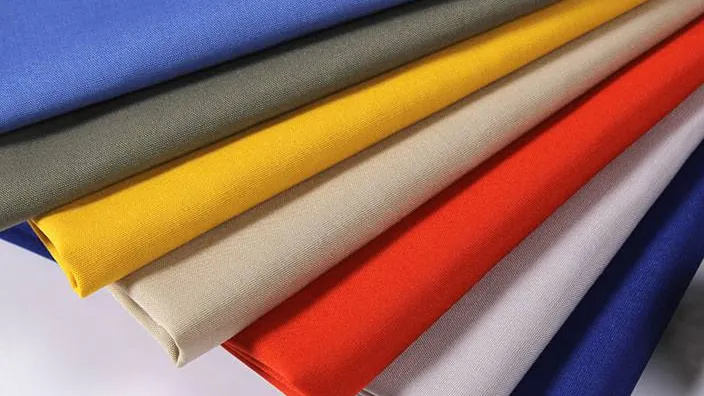
II. Distinctions Between Dyeing and Printing
PART 02
-
There are eight main differences between dyeing and printing:
① Printing has better concealment of grey fabric defects than dyeing.
② Printed fabrics have particularly strict requirements on the weft skew of semi-finished products.
③ Dyeing and printing may have specific requirements for the same type of dye.
④ Dyeing and printing have different pre-treatment requirements for semi-finished products (e.g., whiteness and capillary effect).
⑤ Dyeing solutions contain no or only a small amount of thickening paste, while printing pastes contain a relatively large amount of thickening paste.
⑥ During dyeing, dye penetrates and diffuses fully; in printing, dye is not easy to diffuse and penetrate and requires steaming or baking.
⑦ Dyes in dyeing solutions dissolve easily without the need for co-solvents, whereas printing pastes require the addition of a larger amount of co-solvents.
⑧ Dyeing rarely uses two different types of dyes for color matching, while printing often does.
-
There are three main similarities between dyeing and printing:
① For the same type of fiber, if the same dye is used for both dyeing and printing, the resulting color fastness will be the same.
② The physical and chemical properties of the chemical auxiliaries used are similar.
③ The dyeing and fixing principles of the applied dyes are analogous.
Post time: Dec-11-2025