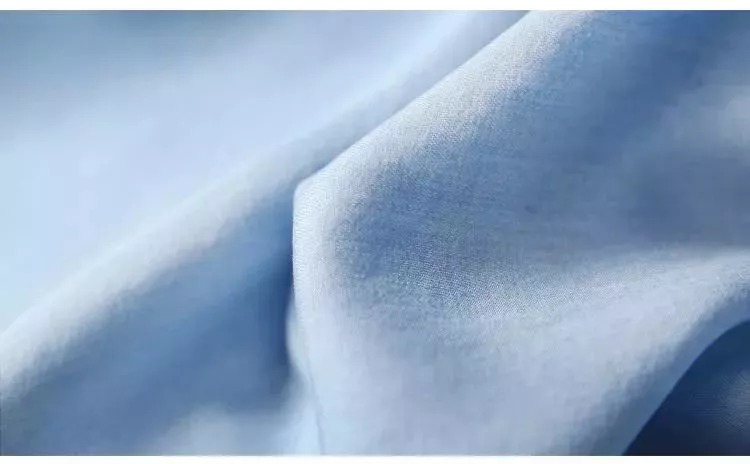
01 Characteristics of Tencel Fabric
Tencel is a 100% natural regenerated fiber developed by the British company Acordis, using 100% natural wood pulp extracted from eucalyptus as raw material, and is known as “the fiber dream of the 21st century”. Its features are as follows: softer hand feel than silk; better hygroscopy than cotton; light and thin, easy to wash and quick to dry.
“Tencel” is the Chinese transliteration of the English word “Tencel”, and it is commonly referred to directly as “Tencel” in Chinese newspapers and magazines. Tencel is a new material. The word Tencel does not appear in the New English-Chinese Dictionary (Supplementary Edition) published by Shanghai Translation Publishing House in 1993 nor in the English-Chinese Dictionary of Textile Industry (Combined Edition of Original and Supplementary Volumes) published by China Textile & Apparel Press in 1995. Internationally, Tencel became popular in the early 1990s, while domestic research and development started in the second half of the 1990s and it gained popularity in the domestic market by the end of the 1990s.
Tencel is a commercial brand of Lyocell fiber (Lyocell refers to cellulose fiber produced by organic solvent spinning, whose generic name is designated by the International Bureau for the Standardization of Man-Made and Synthetic Fibers). Tencel is produced and patented by the British company Courtaulds. Therefore, only Lyocell fiber produced by Courtaulds can be called Tencel. Similarly, only products containing Tencel approved by the company can use the name Tencel or be attached with Tencel hangtags.
Tencel has high strength and can be used as industrial fiber. At the same time, it has the comfort of cotton, the hand feel of silk and good drapability. It is the only new fiber in the world that combines the advantages of synthetic fibers and natural fibers to date. Since its emergence, Tencel has attracted numerous fabric suppliers and garment manufacturers focusing on the development of new fabrics, and has become a frequently used fiber name in recent years. Tencel causes minimal environmental pollution during the production process, hence it is also known as “the green fiber of the 21st century”.
At present, Tencel has the following specifications:
Fineness: 1.4dtex, 1.7dtex, 2.4dtex, 3.3dtex
Average length: 38mm, 51mm (suitable for cotton spinning and medium-length spinning), 60mm, 80mm (suitable for wool spinning system)
There are two types of Tencel: one is the standard type (G100), which is fibrillated Tencel, and the other is type A100, known as non-fibrillated Tencel.
It boasts the hand feel of silk and excellent drapability, and is the only new fiber in the world that integrates the merits of synthetic and natural fibers. Since its launch, Tencel has drawn the attention of countless fabric developers and clothing manufacturers engaged in new fabric R&D, becoming a widely used fiber name in the textile industry. With negligible environmental pollution in its production, Tencel is also hailed as “the green fiber of the 21st century”.
02 Characteristics of Modal Fabric
Modal fiber is a type of cellulose fiber made from pulp of shrubs grown in Europe through a special spinning process. As a cellulose fiber, it is categorized with cotton and is a pure natural fiber.
Modal products are mostly used in underwear production due to their excellent softness and hygroscopy, yet poor fabric stiffness. Modal knitted fabrics are mainly for underwear making. However, Modal’s silvery luster, excellent dyeability and bright color after dyeing make it a suitable material for outerwear. For this reason, Modal is increasingly being used for outerwear and decorative fabrics.
To remedy the defect of poor stiffness, Modal can be blended with other fibers, achieving excellent results. A blend of JM/C (50/50) can make up for this shortcoming, and the fabric becomes brighter with each wash.
Modal has a dry strength close to that of polyester (35cN/tex) and a wet strength slightly lower than that of cotton. It is soft and smooth with a silky hand feel and small wet elongation. The dry elongation of Modal fiber is between that of cotton and viscose, its wet elongation is similar to cotton but lower than viscose. It features low washing shrinkage, and its moisture absorption capacity is 50% higher than cotton with an extremely fast moisture absorption rate. In terms of dyeing properties, Modal fiber absorbs pigments faster and more efficiently than combed cotton, presenting bright colors after dyeing, and it also has good air permeability.
Fine denier Modal fiber meets the requirements of the ECO-TEX standard, is physiologically harmless and biodegradable. It has unique advantages for textiles in direct contact with the human body. Fine denier fiber endows knitted fabrics with comfortable wearing performance, soft hand feel, flowing drapability, charming luster and high hygroscopy.
For these reasons, many warp and weft knitting manufacturers have begun to use this fiber to produce daily wear, pajamas, sportswear and casual wear, as well as lace. When blended fabrics are used for intimate wear, they achieve an ideal effect, keeping the skin dry and comfortable at all times. Even after washing, they still retain good water absorption and softness, all thanks to the smooth surface of the material that prevents fiber entanglement during washing.
Modal also demonstrates good weavability in woven fabric production and can be interwoven with yarns of other fibers to produce a variety of fabrics. Modal products have broad development prospects in modern clothing and accessories.
The main characteristics of Modal fiber are as follows:
① The raw material of Modal fiber comes from natural wood and is biodegradable after use.
② The fineness of Modal fiber is 1dtex, while that of cotton fiber is 1.5–2.5tex and silk is 1.3dtex.
③ Modal fiber is soft and smooth with bright colors. Fabrics made of it have an extremely smooth hand feel, bright surface luster and better drapability than existing cotton, polyester and spun rayon fabrics. It has a silk-like luster and hand feel, making it a natural mercerized fabric.
④ Modal fiber has the strength and toughness of synthetic fibers, with a dry strength of 35.6cN/tex and a wet strength of 25.3cN/tex. Its strength is higher than that of pure cotton and polyester-cotton blends, reducing end breakage during processing.
⑤ The moisture absorption capacity of Modal fiber is 50% higher than that of cotton fiber, which keeps Modal fiber fabrics dry and breathable. It is an ideal material for intimate and health-care clothing, conducive to the human body’s physiological circulation and health.
⑥ Compared with cotton fiber, Modal fiber has good morphological and dimensional stability, endowing fabrics with natural wrinkle resistance and easy-care performance, making them more convenient and natural to wear.
⑦ Modal fiber has good dyeing properties and remains bright as new after multiple washes. It has thorough moisture absorption and good color fastness. Compared with pure cotton, it is more comfortable to wear and avoids the disadvantages of easy fading and yellowing of pure cotton clothing.
Therefore, the fabrics have bright colors and stable wearing properties. Unlike cotton fabrics that become stiffer after 25 washes, Modal fiber fabrics become softer and fuller with each wash, silky soft, mildew-proof, moth-proof, antibacterial, cool and comfortable to wear, and have beauty and skin care effects. It has excellent dyeing properties and bright luster, as well as good natural antibacterial effects and environmental protection, complying with the modern trend of pursuing health and comfort.
03 Characteristics of Bamboo Fiber Fabric
Bamboo fiber yarn is made from high-quality wild mao bamboo fiber from southern China, producing short-staple yarn from bamboo pulp fiber, and it is a green product. Knitted fabrics and clothing made of cotton yarn from this raw material have a unique style distinctly different from cotton and wood-based cellulose fibers: excellent wear resistance, pilling resistance, high hygroscopy, quick drying, high air permeability and drapability, with a smooth hand feel. Blended fabrics woven with such yarn make cotton fibers more soft and improve the appearance of the fabrics.
Modal also exhibits good weavability in the weaving of woven fabrics and can be interwoven with yarns of other fibers to produce a variety of fabrics, boasting broad development prospects in modern clothing and accessories.
Bamboo fiber fabrics have the following outstanding characteristics:
① The raw material of bamboo fiber is taken from natural bamboo and is fully biodegradable after use, in line with the concept of green environmental protection.
② Bamboo fiber has a fineness of about 1dtex, with a delicate and smooth hand feel, better than cotton and Modal in softness and skin-friendliness.
③ Bamboo fiber fabric has a natural faint bamboo fragrance, with excellent natural antibacterial, bacteriostatic and deodorizing properties, which can effectively inhibit the growth of bacteria and keep the skin clean and healthy.
④ Its moisture absorption and perspiration wicking performance are far superior to cotton and other cellulose fibers. It can quickly absorb and release moisture, keeping the human body dry and comfortable, making it an ideal material for summer clothing and intimate wear.
⑤ The fabric has good dimensional stability, low washing shrinkage, and no easy deformation or wrinkling, maintaining a neat appearance after multiple washes.
⑥ It has natural UV resistance, which can block most ultraviolet rays and protect the skin from UV damage.
In particular, bamboo fiber blended with other fibers in a specific ratio can not only reflect the properties of other fibers but also give full play to the characteristics of bamboo fiber, bringing new features to knitted fabrics. Pure and blended yarns (blended with Tencel, Modal, moisture-wicking polyester, negative ion polyester, corn fiber, cotton, acrylic and other fibers in different types and ratios) are the first choice for knitted intimate textiles. In trendy fashion, bamboo fiber fabrics perform better in spring and summer clothing.
Post time: Jan-30-2026