Horizontal stripes are a common weaving defect in circular knitting machine production caused by poor machine adjustment, substandard raw material quality and other factors. There are generally two types: hidden horizontal stripes and monofilament horizontal stripes. Based on the introduction of the structural characteristics of circular knitted fabrics, this paper analyzes the causes from the aspects of raw materials, mechanisms, machine components and process adjustment, and puts forward corresponding preventive and corrective measures.
Causes and Preventive & Corrective Measures of Hidden Horizontal Stripes
Hidden horizontal stripes refer to the phenomenon of uneven density on the fabric surface caused by periodic changes in loop size during one operation cycle of the machine. Generally speaking, raw materials have a low probability of causing hidden horizontal stripes. This defect is mostly induced by periodic tension imbalance due to delayed adjustment after mechanical wear.
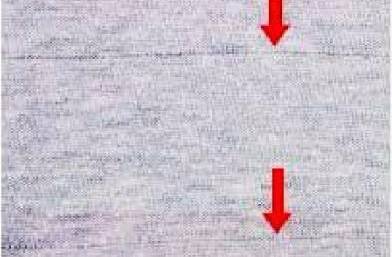
1.1 Causes
a. Due to low installation accuracy or severe wear caused by equipment aging, the levelness and concentricity deviation of the circular knitting machine cylinder exceed the allowable tolerance. A common problem is the excessive gap between the positioning pin of the main drive gear plate and the frame positioning groove, which leads to unstable operation of the cylinder and seriously affects yarn feeding and loop withdrawal.
In addition, equipment aging and mechanical wear increase the longitudinal and radial runout of the main drive gear plate, resulting in cylinder concentricity deviation, yarn feeding tension fluctuation, abnormal loop size, and even hidden horizontal stripes on the gray fabric in severe cases.
b. During production, flying fibers and other foreign matters get embedded in the adjusting slider of the variable speed disc of the yarn feeding mechanism, which impairs its roundness, causes abnormal speed of the synchronous timing belt and unstable yarn feeding quantity, thus leading to hidden horizontal stripes.
c. Circular knitting machines adopting passive yarn feeding mechanisms are difficult to overcome the drawback of large yarn tension difference during feeding, which is prone to cause unexpected yarn elongation and variation in yarn feeding quantity, further forming hidden horizontal stripes.
d. Circular knitting machines with intermittent take-up mechanisms experience large tension fluctuation during take-up, which easily leads to differences in loop length.
1.2 Preventive & Corrective Measures
a. Electroplate the positioning surface of the gear plate to an appropriate thickness and control the gear plate runout within 0.01–0.02 mm. Polish the bottom ball track, apply lubricating grease, and level the bottom of the cylinder with a soft and thin elastomer pad to strictly control the cylinder radial runout within about 0.02 mm. Regularly calibrate the sinker cam, control the distance between the sinker cam and the tail of the new sinker within 0.30–0.50 mm, and minimize the position deviation of each sinker cam within 0.05 mm, so as to ensure consistent yarn holding tension of sinkers during loop withdrawal.
b. Control the workshop temperature and humidity. Generally, maintain the temperature at around 25℃ and relative humidity at 75% to prevent the adsorption of flying fibers and dust caused by static electricity. Meanwhile, take necessary dust collection measures to keep the workshop clean, and strengthen machine maintenance to ensure the normal operation of all rotating components.
c. Transform the passive yarn feeding mechanism into a storage-type positive yarn feeding mechanism to reduce tension difference during yarn guiding. It is recommended to install a speed monitoring device to stabilize yarn feeding tension.
d. Transform the intermittent take-up mechanism into a continuous take-up mechanism to ensure the continuity of fabric winding and the stability and uniformity of winding tension.
Causes and Preventive & Corrective Measures of Monofilament Horizontal Stripes
Monofilament horizontal stripes refer to the phenomenon where one or several courses of loops on the fabric surface are significantly larger, smaller or more uneven in density than other courses. In actual production, monofilament horizontal stripes caused by raw materials are the most common.

2.1 Causes
a. Poor yarn quality and monofilament color difference (e.g., hard-twisted yarn, chemical filament of different batches, undyed filament, or mixed use of yarns with different counts) directly lead to monofilament horizontal stripes.
b. Large differences in package size or package defects such as shoulder bulge and edge collapse cause uneven yarn unwinding tension, which easily results in monofilament horizontal stripes. This is because different package sizes lead to different winding points and unwinding balloon diameters, and thus significant differences in the variation law of unwinding tension. During knitting, when the tension difference reaches the maximum value, it will cause inconsistent yarn feeding quantity, further leading to uneven loop size.
c. When processing porous and ultra-fine denier raw materials, the yarn path should be kept as smooth as possible. Slight roughness or grease solidification on any yarn guide hook can easily cause the breakage of multiple monofilaments, followed by monofilament color difference. Compared with processing conventional raw materials, this type of raw material has more stringent requirements on equipment, and the finished fabric is more prone to monofilament horizontal stripes.
d. Improper machine adjustment (e.g., excessively deep or shallow needle-pressing cam at a certain position) causes abnormal yarn tension and differences in loop size.
2.2 Preventive & Corrective Measures
a. Ensure raw material quality and prioritize raw materials from reputable manufacturers. Impose strict requirements on the dyeing performance and physical indicators of raw materials: the color fastness standard should be above grade 4.0, and the coefficient of variation of all physical indicators should be minimized.
b. It is optimal to select constant-weight packages for processing. Choose packages with similar winding diameters for machine loading, and strictly reject packages with poor appearance (e.g., shoulder bulge and edge collapse). During dyeing and finishing, it is recommended to conduct sample dyeing in parallel. If horizontal stripes appear, re-dye the fabric with non-sensitive colors or add stripe eliminating agents to eliminate or mitigate the defect.
c. When processing porous and ultra-fine denier raw materials, strictly inspect the raw material appearance for loose fibers. In addition, clean the yarn path and check whether all yarn guides are smooth. During production, monitor the weft accumulator for entangled loose fibers, and stop the machine immediately to identify the cause once such a problem is found.
d. Ensure consistent needle-pressing cam depth across all yarn feeding paths. Use a yarn length measuring instrument to finely adjust the loop-forming position of the cam on each path, so as to maintain uniform yarn feeding quantity. In addition, inspect the loop-forming cam on each path for wear, as the adjustment of the loop-forming cam directly affects yarn feeding tension, which in turn determines the final loop size.
Conclusion
- Monofilament horizontal stripes caused by raw material quality are the most common defect in circular knitted fabric production. Therefore, selecting raw materials with good appearance and excellent quality is essential for circular knitting machine production.
- Daily machine maintenance is of great importance. Wear of some machine components after long-term operation will increase the levelness and concentricity deviation of the circular knitting machine cylinder, which is highly likely to cause horizontal stripes.
- Improper adjustment of the needle-pressing cam and sinker loop during production will lead to abnormal loops, increased yarn feeding tension difference, inconsistent yarn feeding quantity, and eventually horizontal stripes.
- Due to the loop structure characteristics of circular knitted fabrics, fabrics with different structures vary in their sensitivity to horizontal stripes. Generally speaking, single-jersey fabrics (e.g., jersey) have a higher probability of developing horizontal stripes and thus require stricter requirements for machinery and raw materials. In addition, fabrics processed with porous and ultra-fine denier raw materials also have a relatively high risk of horizontal stripes.
Post time: Dec-24-2025